by Nish Fofaria
•
4 September 2026
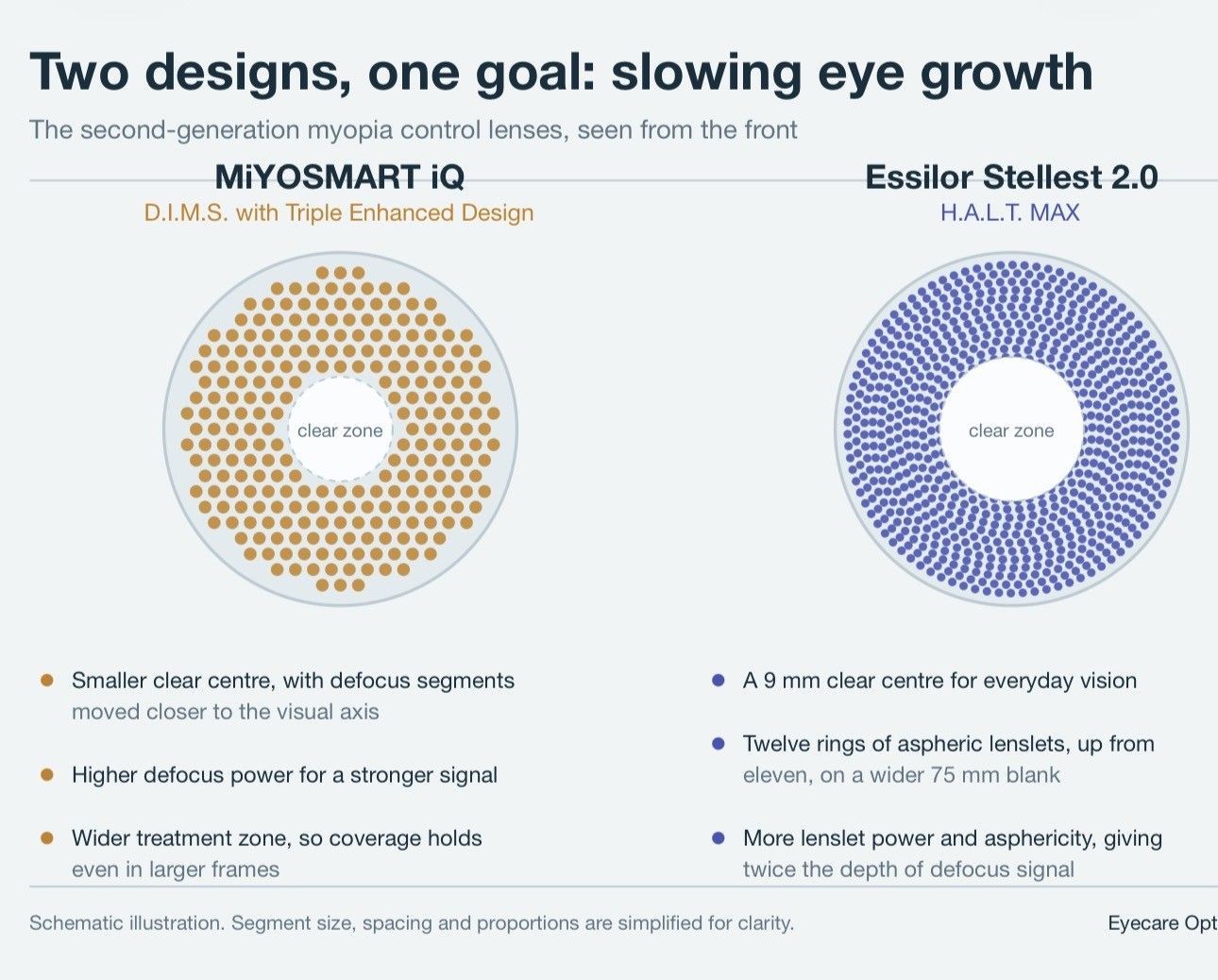
For the last few years, parents of short-sighted children have essentially had two leading spectacle options: HOYA's MiYOSMART and Essilor's Stellest. Both are well evidenced, both slow the eye from growing too long, and both have quietly changed how we manage childhood myopia in practice. In 2025–2026, both manufacturers released second-generation designs — **MiYOSMART iQ** and **Essilor Stellest 2.0**. The headline claims are striking. Here's what has actually changed, what the evidence shows, and how we're thinking about it clinically. First, a reminder of why this matters Myopia isn't just a prescription problem. As a child's eye grows longer, the risk of sight-threatening conditions in adult life rises — retinal detachment, myopic maculopathy, glaucoma and early cataract. Every fraction of a millimetre of axial elongation we prevent in childhood is a permanent reduction in that lifetime risk. Ordinary single-vision glasses correct blur. They do nothing to slow the underlying growth. That distinction is the whole reason myopia control lenses exist. MiYOSMART iQ — HOYA's Triple Enhanced Design The original MiYOSMART, developed with The Hong Kong Polytechnic University, uses D.I.M.S. technology: a clear central zone for the prescription, surrounded by a honeycomb of tiny defocus segments that sit in front of the peripheral retina and signal the eye to slow its growth. MiYOSMART iQ keeps that principle and refines it in three ways — what HOYA calls the **Triple Enhanced Design (DIMS TED)**: 1. **A smaller central clear zone**, with the defocus segments moved closer to the visual axis, so the near-peripheral retina is stimulated more continuously. 2. **Higher defocus power**, producing a stronger treatment signal. 3. **An extended treatment zone**, keeping coverage consistent even in the larger frames children actually want to wear. What the data says At ARVO 2026 in Denver, HOYA and PolyU presented 12-month results from a randomised controlled trial in 196 children: - Roughly **nine out of ten children showed no clinically relevant myopia progression** over the first year of wear. - Across the whole group, mean spherical equivalent changed by **+0.155 D with iQ versus –0.511 D** in single vision, with axial length changing **0.019 mm versus 0.310 mm**. - In children aged **four to six** — a group myopia control lenses have rarely been tested in — efficacy was **65% for refractive error and 44% for axial length**, with mean changes of –0.220 D and 0.266 mm versus –0.635 D and 0.475 mm in single vision. - Earlier six-month interim data suggested iQ was around **twice as effective as the original MiYOSMART** at controlling both progression and eye growth. The evidence in four- to six-year-olds is arguably the most important part. Early-onset myopia progresses fastest and carries the highest lifetime risk, and until now we have had very little lens data in that age group. Essilor Stellest 2.0 — H.A.L.T. MAX Stellest takes a different optical route. Its **H.A.L.T.** technology (Highly Aspherical Lenslet Target) uses concentric rings of tiny aspheric lenslets to create a *volume* of non-focused light in front of the retina, rather than a single defocus plane. Stellest 2.0 upgrades this to **H.A.L.T. MAX**: - **Increased lenslet power and asphericity**, pushing the volume of non-focused light further from the retina and spreading it more widely — roughly twice the depth of signal. - **Twelve rings of lenslets instead of eleven**, and a wider 75 mm blank, which meaningfully widens frame choice. Essilor is careful to note that twice the signal depth does not mean twice the efficacy — a caveat worth repeating to parents. What the data says Stellest 2.0 was tested in a 12-month prospective, randomised, double-masked **contralateral crossover trial** in Singapore in 50 children aged six to ten. Each child wore a 2.0 lens in one eye and a first-generation Stellest in the other for six months, then swapped. - At six months, axial elongation was **0.043 mm in the 2.0 eyes versus 0.105 mm** in the first-generation eyes. - Over the full year, the cumulative difference was **0.107 mm less elongation** with 2.0, and **0.21 D less progression**. - No changes in binocular vision and no intervention-related adverse effects were reported. For context, the first-generation Stellest has two-year data showing around **71% reduction in progression and 53% reduction in axial elongation** against single vision, and six-year follow-up showing sustained effect. That long tail of evidence still belongs to the original lens, not to 2.0. Our honest read on the evidence Both lenses are genuine engineering advances, and the direction of travel — stronger signal, closer to the visual axis, wider coverage — is consistent across two independent manufacturers. That convergence is reassuring. But a few things deserve saying plainly: - **Both datasets are manufacturer-funded and short.** Twelve months is enough to show a signal, not enough to confirm a durable effect. Myopia control is a five- to ten-year project. - **The MiYOSMART iQ trial has been presented at conference but not yet fully peer reviewed.** We read it with the same caution we'd apply to any new lens. - **Stellest 2.0 was compared against Stellest, not against ordinary glasses.** That's an ethically sensible design, but it means the effect size is an *increment* on an already good lens. The crossover trial also had no washout period and no cycloplegia, which the authors themselves acknowledge. - **"No progression on average" is an average.** Some children in these trials still progressed. No lens is a guarantee. None of that is a reason to hold back. It is a reason to keep measuring — which is why axial length monitoring, not just refraction, sits at the centre of how we run myopia management. Which lens for which child? There is no head-to-head trial, so anyone claiming a clear winner is guessing. In practice the choice usually comes down to: - **Age at onset.** MiYOSMART iQ now has trial data down to age four, which matters for very early presenters. - **Rate of progression.** Fast progressors, and children who have progressed despite a first-generation lens, are the clearest candidates for either second-generation design. - **Frame choice and fit.** Both designs depend on accurate centration, and Stellest 2.0's wider blank helps with larger frames. Getting this right is not a detail — it's the difference between the treatment working and not. - **Whether spectacles are the right modality at all.** Contact lenses, orthokeratology and low-dose atropine remain part of the conversation, sometimes in combination. And whichever lens a child wears, the basics still count: full-time wear, **at least two hours outdoors a day**, and sensible near-work habits. Availability MiYOSMART iQ began reaching UK practices during 2026. Stellest 2.0 launched first in China in late 2025 with international rollout through 2026. Availability is moving quickly — if you'd like to know what we can fit right now, just ask. Talk to us If your child is short-sighted, or their prescription has changed since their last check, a myopia assessment gives you a proper baseline — including axial length measurement — and a clear plan. **Eyecare Opticians** 307 Richmond Road, Ham, Kingston upon Thames, KT2 5QU 020 8549 0331 *This article is for general information and isn't a substitute for a personal clinical assessment. Lens suitability is determined by your optometrist.*